
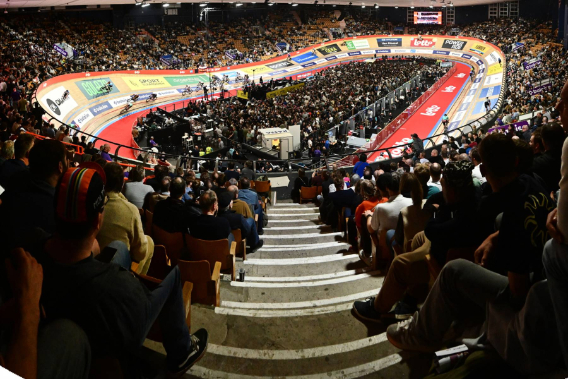
Track cycling is one of cycling's purest forms—riders racing on steeply banked indoor velodromes aboard specialized fixed-gear bikes with no brakes. Born in the late 19th century, track cycling has evolved from simple pursuit races into a complex sport featuring multiple disciplines that test speed, endurance, tactics, and bike handling. While Olympic track cycling captures global attention every four years, the sport's true soul lives in Europe's winter velodrome circuit, where tradition, spectacle, and world-class competition converge in events that run deep into the night.
And nowhere does track cycling shine brighter than at the Ghent Six-Days.
Six-Day Racing: The Ghent Experience
Six-day racing traces its origins to 1878 London, where cyclist David Stanton wagered he could ride 1,000 miles over six consecutive days. What began as sleep-deprived endurance marathons evolved into the modern format: two-rider teams competing over six consecutive evenings in a variety of disciplines, accumulating laps and points to determine the overall winner. The "Madison" format—named after New York's Madison Square Garden where it was developed—remains the centerpiece, with partners taking turns racing while allowing each other rest periods through perfectly timed hand-sling exchanges.
While dozens of six-day races once dotted the European calendar, today only Ghent and Rotterdam maintain the full six-day format. The 84th edition of the Lotto Six Days of Flanders-Ghent, held November 18-23, 2025, proved once again why this event remains track cycling's crown jewel.

The magic unfolds at 't Kuipke velodrome in Citadelpark, a historic venue that's hosted six-day racing since 1922. The compact 166-meter wooden oval with its steep banking creates an intensity impossible to replicate in larger venues. British sprint legend Mark Cavendish famously called it a "wall of death" before winning here with Bradley Wiggins in 2016. Every crash, every hand-sling, every desperate sprint for points unfolds mere meters from spectators—the riders' pain is palpable, their tactical discussions audible between efforts.
But what truly sets Ghent apart is the atmosphere. Over 40,000 spectators packed 't Kuipke across the six nights of the 2025 edition, creating an experience unlike any other in cycling. A DJ spins music throughout the racing, lights flash and pulse in time with the action, Belgian beer flows freely, and the smell of frites fills the air. The evening programs run from 6 PM until 2 AM, transforming the velodrome into a late-night party where world-class sport provides the soundtrack.
It's part sporting event, part nightclub, part Belgian cultural institution. In Flanders, cycling isn't merely a sport—it's woven into the regional identity. The Ghent Six marks the region's seasonal transition from autumn to winter as reliably as the first frost, a tradition that resonates across generations.
Technical Brilliance: The Riders
Six-day racing demands a skill set that few cyclists possess. Success requires mastering multiple disciplines, each testing different attributes, all while maintaining performance across six consecutive late nights when the body craves sleep.
Endurance and concentration form the foundation. Racing from 6 PM to 2 AM for six straight nights pushes physical and mental limits. Riders must stay sharp for tactical decisions even as fatigue accumulates, maintaining focus when every muscle aches and concentration wavers.
Explosive sprint power separates contenders from champions. The elimination races remove the last rider across the line every two laps, creating frantic positioning battles. Points races feature intermediate sprints every few laps, rewarding those who can produce repeated efforts. The Madison itself punctuates long steady-state racing with sudden explosive exchanges.
Tactical acumen determines outcomes as much as physical prowess. Teams must decide when to attack for laps, when to conserve energy, when to contest intermediate sprints for points. The Madison hand-sling exchange—where the resting rider propels their partner back into action with a push—must be executed seamlessly at high speed. Misjudge it by inches or split seconds, and the team loses valuable momentum.
Bike handling skills get tested constantly on the steep banking. Derny races see riders drafting behind motorized pacers at speeds exceeding 70 kilometers per hour. The Keirin features a motorized bike pacing riders for three laps before unleashing an explosive sprint. On 't Kuipke's tight 166-meter oval, riders navigate these speeds mere centimeters apart, making split-second decisions that separate spectacular wins from spectacular crashes.
The 2025 Ghent Six featured riders who embodied this complete skill set. Belgian world champions Lindsay De Vylder and Fabio Van den Bossche demonstrated championship-level patience—waiting five full days before launching their winning attack. Olympic gold medalist Benjamin Thomas brought his omnium versatility to the Madison format. German veterans Roger Kluge, a multiple six-day winner and former world champion, paired with Tim Torn Teutenberg, who won three gold medals at the 2025 European Track Championships. Italian legend Elia Viviani, the Olympic Omnium champion, chose this prestigious event for his final competitive outing.
This depth of talent—Olympic medalists, world champions, and track specialists—elevated the 2025 edition into a showcase of track cycling's elite tier.
The Machines: Track Bikes Built for Speed
The riders at Ghent compete on some of the most specialized bicycles in cycling—pure track bikes engineered for velodrome racing. Unlike road bikes or even the fixed-gear "fixies" popular with urban cyclists, these are purpose-built speed machines.
Track bikes are defined by their simplicity and rigidity. They feature a fixed-gear drivetrain with no freewheel mechanism, meaning the pedals never stop moving when the bike is in motion. There are no brakes—on a velodrome where everyone moves in the same direction, brakes would actually create a safety hazard by allowing unpredictable stopping. The bikes feature aggressive geometry with steep head tube angles around 74 degrees and elevated bottom brackets to prevent pedal strikes on the banked turns.
The frames are built for maximum stiffness rather than comfort, transferring every watt of power directly to the rear wheel. Round fork blades provide superior lateral rigidity for hard out-of-the-saddle sprinting. Deep-section or disc wheels minimize aerodynamic drag, while narrow high-pressure tires (often 23-25mm) reduce rolling resistance.
At the elite level of Ghent Six-Days, riders typically compete on carbon fiber frames from premium manufacturers. Brands like Argon 18, Canyon, Factor, and Felt dominate the professional track cycling scene. Argon 18's Electron Pro has become particularly prominent, used by multiple national teams and world champions. These are cutting-edge machines that represent the pinnacle of track cycling technology.
For six-day racing, riders often use gearing around 84-88 inches (common ratios like 48x15 or 50x16), which balances acceleration for the Madison exchanges with top-end speed for sprint efforts. The gearing choice is highly personal—too high and riders can't accelerate out of the exchanges; too low and they can't generate maximum speed in the sprints.
Van den Bossche and De Vylder's track record on opening night—clocking 8.406 seconds on the 166-meter lap to break a five-year-old record—demonstrated how rider skill and machine precision combine. At that speed, every component must perform flawlessly: the fixed drivetrain transferring power without slippage, the carbon frame flexing just enough to absorb vibrations without wasting watts, the wheels cutting through air with minimal drag.

The 2025 Race: A Battle to the Final Lap
The 2025 edition delivered the kind of nail-biting drama that six-day racing was made for. Each evening's program featured a rotating cast of events testing different skills:
Madison races formed the backbone of competition, where teams accumulated crucial laps and points through tactical racing and perfectly timed exchanges.
Elimination races created positioning chaos as riders battled to avoid being last across the line every two laps, with the field shrinking until only one remained.
Time trials rewarded pure speed and aerodynamics, with riders posting individual efforts against the clock.
Derny races saw riders drafting behind motorized pacers in high-speed pursuits showcasing bike handling at 70+ kilometers per hour.
Points races featured intermediate sprints every few laps, rewarding aggressive racing and tactical positioning.
Keirin races began with a motorized pacer leading riders for three laps before unleashing an explosive sprint to the finish.
This varied program demanded versatility—riders couldn't simply specialize in one discipline but needed to excel across all formats while maintaining performance over six consecutive nights.
The Dramatic Final Day
Entering the final Madison on Sunday, November 23, four teams sat on the same lap, separated only by points. Dutch-Belgian pair Yoeri Havik and Jules Hesters led with 323 points, holding a slim advantage over Van den Bossche and De Vylder's 320 points. Jasper De Buyst and the departing Elia Viviani sat third with 274 points, while German veterans Roger Kluge and Tim Torn Teutenberg remained in contention with 200 points.
The final Madison began explosively. De Buyst and Viviani immediately attacked, gaining a crucial lap in the opening phase. But the other favorites quickly responded, bringing the race back together. Then Yanne Dorenbos and Vincent Hoppezak made their move, positioning themselves among the lead teams for a potential podium spot.
Havik and Hesters won the first sprint, extending their advantage. They dominated the second sprint as well, and when Hesters took the third intermediate sprint, their lead had grown to 19 points. For Van den Bossche and De Vylder, the mathematics were brutal: they needed to gain a full lap to leapfrog the leaders.
The Decisive Attack
With 15 laps remaining, Van den Bossche and De Vylder launched their attack. On the steep banking of 't Kuipke, the world champions put everything on the line. Havik and Hesters had no answer as the Belgian duo drove relentlessly forward, the crowd volume rising with every rotation.
Four laps from the finish, Van den Bossche and De Vylder rejoined the main group, having successfully gained their lap. The move was decisive. After six days of racing, countless Madison exchanges, elimination races, dernys, time trials, and points races, the world champions had timed their attack perfectly, stealing victory in the closing minutes.
First-Time Glory at Home
For Van den Bossche, the victory carried special significance. It marked the first time in 13 years that Ghent welcomed Belgian Madison world champions to race on home soil. While De Vylder had won Ghent twice before with previous partners, this was Van den Bossche's maiden victory at Belgium's most prestigious track event. Last year, he'd won alongside France's Benjamin Thomas, but claiming the rainbow jersey with De Vylder at the World Championships in Copenhagen set the stage for this homecoming triumph.
The emotion was visible as the two Belgians crossed the line in the early hours of Sunday morning. After 12 teams, six grueling nights of racing, and a field stacked with Olympic medalists and world champions, they had prevailed on cycling's most demanding stage.
Viviani's Farewell
The 2025 Ghent Six gained additional poignancy from serving as the farewell race for Elia Viviani, the 35-year-old Italian sprint legend. A former Olympic Omnium champion, multiple world champion on track and road, and one of the great characters of professional cycling, Viviani chose the Ghent Six for his final competitive outing.
Partnered with Belgian track specialist Jasper De Buyst, Viviani didn't coast to retirement. The Italian-Belgian duo fought for the overall victory throughout the week, sitting third entering the final Madison. Though they ultimately finished third overall, unable to bridge to the winners when Van den Bossche and De Vylder made their decisive move, Viviani went out fighting.
The Ghent crowd, known for their appreciation of cycling history and character, gave Viviani a standing ovation during his emotional farewell speech—a fitting tribute to a career that spanned Olympic glory, Grand Tour stage victories, and countless track triumphs.
Notable Performances
The 2025 edition showcased the depth of international track cycling talent beyond the podium finishers.
Olympic gold medalist Benjamin Thomas, partnering with Oscar Nilsson-Julien, featured prominently in the racing despite finishing further down the classification after an early mistake cost them three laps on the opening night. That single error demonstrated how unforgiving six-day racing can be—one lapse in concentration can erase hours of brilliant riding.
The Dutch brought strong representation through multiple teams, with Havik and Hesters' runner-up finish serving as consolation after dominating much of the week. Their tactical racing and sprint prowess kept them in the lead position until those final 15 laps changed everything.
Lotte Kopecky, Belgium's double world road champion and track powerhouse, added another compelling storyline with her return to competition after suffering a fractured vertebra in September. The 29-year-old had crashed out of the Tour de l'Ardèche, initially believing her injuries were minor, only to discover she'd broken a vertebra in her back. Two months of careful recovery followed before her comeback at the Belgian Track Championships showed she'd lost none of her dominance. At Ghent, competing in the elimination and points races on Friday and Saturday nights, Kopecky demonstrated the form that's made her one of cycling's most versatile champions.
Final Standings
Men's Overall Classification:
The margins tell the story: separated by a single lap gained in the final 15 rotations, decided after six days and countless individual competitions. This is six-day racing at its finest—tactical chess played at 60 kilometers per hour, where patience and explosive power must coexist, where experience battles youth, and where the smallest tactical decision can determine ultimate victory.

Preserving Tradition and Looking Ahead
As track cycling faces an uncertain future globally, with the UCI allowing events to shorten from six days to maintain commercial viability, Ghent remains defiantly traditional. The 2025 edition ran the full six nights, maintaining a format and atmosphere that dates back over a century.
This isn't stubbornness but recognition that Ghent's magic lies in its authenticity. While some six-day events struggle with attendance or have shortened to three or four days, Ghent thrives precisely because it remains unapologetically itself: six full nights of racing, Belgian tradition, and the hypnotic rhythm of wheels on wooden boards.
The sold-out crowds across all six nights of the 2025 edition proved this approach works. Spectators didn't just watch world-class competition—they participated in a cultural experience that transcends sport. The late-night atmosphere, the intimacy of 't Kuipke, the blend of serious racing and festival vibes creates something irreplaceable in modern cycling.
As Van den Bossche and De Vylder stood on the podium in the early hours of Sunday morning, rainbow jerseys gleaming under 't Kuipke's lights, they joined a century-long honor roll of Ghent Six champions. Names like Patrick Sercu, who won the event an astonishing seven times, and Eddy Merckx, Belgium's greatest cyclist, have graced this same podium. Their victory continues cycling's living history, connecting modern champions to legends of the past through the shared experience of conquering Ghent's steep banking and unforgiving format.
For anyone who loves cycling, experiencing the Ghent Six should be a bucket-list priority. It's accessible yet world-class, traditional yet thrillingly modern, deeply Belgian yet universally appealing. Where else can you watch Olympic champions and world champions race at midnight while a DJ spins music and the crowd sings between events? Where else does sport, culture, and pure spectacle blend so seamlessly?
The 2025 edition proved once again why the Ghent Six-Days remains track cycling's crown jewel. As long as the wooden boards of 't Kuipke resound with the whir of wheels and roar of crowds, this Belgian institution will continue to define what makes track cycling special—a reminder that in an age of shortened attention spans and streamlined formats, there's still room for events that demand six full nights of commitment from riders and spectators alike.
The tradition endures because it deserves to endure.







No comments yet. Be the first to comment!